

Tactical-driven whipsaw trades can result in underperformance for advisors and investment allocators who rely on tactical signals. A sharp price reversal can turn a seemingly smart investment trade into a costly mistake within days, or sooner. This pattern, known as a whipsaw trade, appears often in tactical strategies built on trend following and momentum.
This article explains what whipsaw trades are, how trend and momentum approaches handle them differently, and what allocators, advisors, and investors can do to mitigate the impact of whipsaw trades.
What Are Whipsaw Trades?
A whipsaw trade happens when a price moves sharply in one direction, prompts an investor to take action, and then reverses course almost immediately. The name refers to an old two-person saw. That saw cuts on the push and again on the pull.
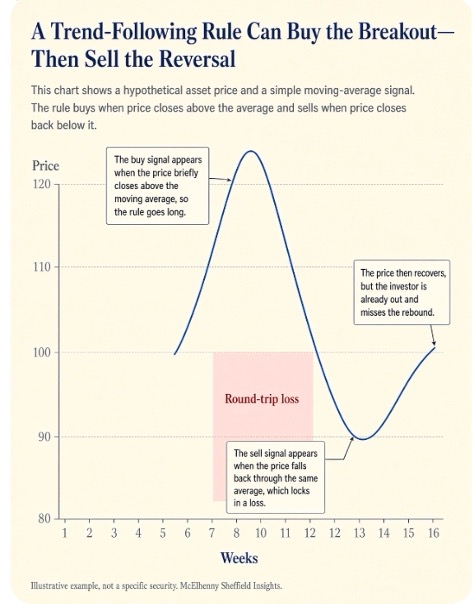
A common whipsaw pattern is when a stock breaks above a specific level and a trend-following rule says buy. Within weeks or even days, the price may fall back below the point where an investor bought it, triggering the investor to sell the position; then soon after, the price climbs again, although the investor no longer owns the position.
The result is a loss on the way down and a missed gain on the way back up, a very frustrating set of events.
Whipsaw trades occur more often when a market has no clear direction, when stock prices move sideways, not higher or lower. In these so-called sideways markets, a stock’s price often stays inside a narrow range, but can appear to move out of range, which can trigger a false signal to buy or sell because the price briefly pokes through a level or one average crosses another. If you act on a false signal, it can create a trading loss, which can add up when it happens repeatedly.
How whipsaw trades may look
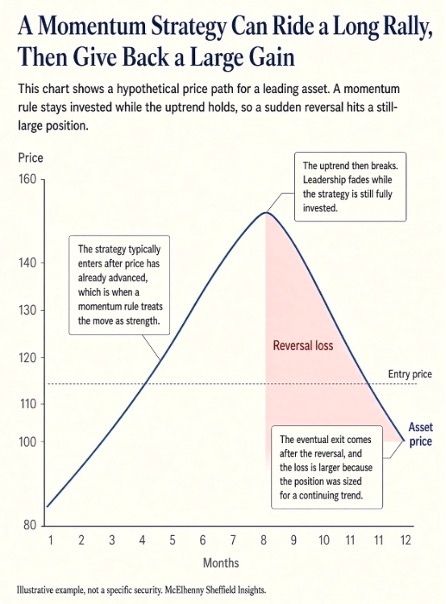
The charts below illustrate how a whipsaw trade may appear in trend-following and momentum strategies. A market’s abrupt reversal can trigger a false buy or sell signal, potentially leading to losses or missed gains in either approach. The charts also show why the timing, frequency, and impact of whipsaw trades can differ across tactical strategies.
How Tactical Managers Look to Mitigate Whipsaw Trade Impact
Tactical investment managers rely on several tools to soften the sting of whipsaw trades. None, however, can eliminate whipsaw.
Signal confirmations
Second opinions rarely hurt when markets are noisy and volatile. This mitigating tactic involves waiting for a second piece of evidence, such as waiting for a price to close beyond a moving average for several days in a row before acting. A short “wait-and-see” pause looks to filter out much of the market’s static.
Stop orders
A stop-loss order is intended to limit further loss if the stop price is reached, reigning in how much a manager can lose on a single trade. Often, managers may set a stop level based on how much the price typically moves, rather than a fixed number for every trade. When the market is calm, managers may set a tighter stop, so a smaller drop triggers the sale. When the market turns turbulent, a wider stop means the sell price sits further away, so ordinary swings do not trigger an unnecessary sale. Managers may also use portfolio-level risk limits intended to constrain aggregate losses.
Longer lookbacks
A lookback period is the span of past price history many managers review before making a trade decision. Some may look at the last three-month timeframe; others may look back to one year. A short period can be misled by a single good or bad week. A longer lookback may help managers avoid reacting to short-term fluctuations
Risk filters (volatility, credit, breadth)
Managers may add risk filters such as rising volatility, widening credit spreads, deteriorating market breadth, or other signals confirming market stress to reduce allocations before a reversal. The tradeoff is that early warning signs don’t always lead to an actual market move.
Broader diversification
Many tactical managers combine trend-following and momentum strategies to manage risk. The whipsaw caused by trend-following and by momentum whipsaws stem from different causes, and no single fix covers both.
Different markets and strategies may not whipsaw at the same time, so a loss in one area may be offset by stability or gains elsewhere. By not concentrating risk in a single signal or market, managers reduce the odds that one bad stretch of false signals will meaningfully hurt overall portfolio returns.
Why Allocators, Advisors, and High-Net-Worth Investors Think Differently About Whipsaw Trades
Not all investors think alike about whipsaw trades.
Institutional allocators, including pension funds and endowments, may fear an undisciplined manager. Trend and momentum managers who can’t articulate their process for handling whipsaw trades and model signals raise questions about discipline.
For advisors, multiple whipsaws may erode their clients’ trust. Clients tend to notice trading activity that results in losses or missed opportunities, and some see it as a red flag or a reason to leave. That is one reason many advisors prefer a rules-based strategy they can explain to clients, helping them to stick with it.
Some investors feel whipsaw losses both personally and emotionally because of loss aversion, where the pain of a loss is much greater than the joy of an equivalent gain. Regret over losses can push an investor to abandon a sound strategy at the worst possible time.
Frequently Asked Questions About Whipsaw Trades
Can both trend-following and momentum be whipsawed?
Yes, both can be whipsawed, but in different ways. Trend-following faces frequent, smaller reversals, mostly in choppy or range-bound markets. It typically tracks a single asset’s direction, which can trigger a buy or sell signal when the price moves outside its recent range. Because these signals are tied to specific prices, sideways markets can mean many quick buy-and-sell cycles. This is the most common type of whipsaw.
Momentum strategies, by contrast, get whipsawed less often, but when reversals happen, they tend to be larger and more costly, since momentum relies on sustained price moves rather than short-term thresholds.
Are certain asset classes more prone to whipsaw than others?
Yes. Less liquid or more volatile markets, such as small-cap stocks or emerging-market currencies, tend to see more frequent price swings within a narrow range, which can raise the risk of a whipsaw. Highly liquid, lower-volatility markets like large-cap equities or US Treasury bonds may produce fewer false breakouts, giving trend and momentum signals more room to work before triggering a reversal. Still, no asset class or strategy eliminates whipsaw risks.
Why is whipsaw trading often linked to tactical strategies?
Whipsaw is most closely tied to tactical investing because trend-following and momentum strategies follow set rules, which often means they generate rules-based signals that can be monitored over time.
Can whipsaw trades be eliminated?
Any rule that reacts to price movement will occasionally react unpredictably. Confirmation filters, wider stops, and longer lookback periods aim to reduce whipsaw frequency and cost. Each of these tools introduces a trade-off, since signals arrive later and a strategy may capture less of a market move. Regardless of how a strategy is designed, there will always be periods where the market does not “cooperate,” causing underperformance.
What is a stop-loss order, and how does it relate to whipsaw?
A stop-loss order automatically closes a position once the price reaches a set level. It is intended to limit further loss if filled at or near the stop. A stop placed close to the current price is prone to triggering on ordinary market movement, which can produce a whipsaw if the price reverses shortly afterward. A stop placed too far away may reduce whipsaw frequency, but leaves the position open to a larger loss before the stop is reached. This is the common tradeoff in a rules-based strategy: tighter stops reduce single-trade losses but increase whipsaw frequency, while wider stops reduce whipsaws but increase potential loss on any given trade.
How does a whipsaw trade differ from slippage?
Slippage is the difference between the price an investor expects and the price received when a trade executes, often caused by fast-moving markets or low liquidity. A whipsaw trade, by contrast, is a distinct event. Slippage can happen within a single trade in either direction. A whipsaw typically describes a round-trip loss caused by a false signal followed by a reversal in the opposite direction.
Whipsaw Trades and Tactical Investing: What Allocators and Advisors Need to Know
Whipsaw trades are a structural feature of trend and momentum investing. They alone are not a sign of a broken investment strategy and should not be treated that way.
A tactical investment strategy that seeks confirmation before acting, sets sensible loss limits, and diversifies investments can turn whipsaw trades from a recurring headache into a manageable cost of a strategy aimed at protecting capital during the worst market environments while also growing client portfolios during the good times.
About McElhenny Sheffield
McElhenny Sheffield believes that avoiding material losses is the foundation of successful long-term investing. Risk management and capital preservation are the firm’s top priorities.
The firm is committed to protecting investors’ financial futures through a rules-based, tested, momentum-driven, trend-following tactical ETF strategy, and positioned as a tactical satellite portfolio for advisors who need to protect their clients’ core portfolio while still seeking growth.
Clients include independent-thinking investment advisors across the U.S., large investment allocators, and high-net-worth individuals and families looking for a second opinion. McElhenny Sheffield also provides sub-advisory services for RIAs and financial advisors. The firm was founded in Dallas, TX, in 2000, and manages more than $798 million in assets as of June 30, 2026.
Important Information
The information contained in this article has been obtained from sources believed to be reliable; however, its accuracy, completeness, and timeliness cannot be guaranteed. Any opinions or estimates reflect the author’s judgment as of the date of publication and are subject to change without notice. This material is provided for informational purposes only and should not be construed as legal, tax, or investment advice. Investors should consult their tax advisor or legal counsel for advice and information concerning their particular situation. See other important disclosures below.
____________________________________________________________________________________