
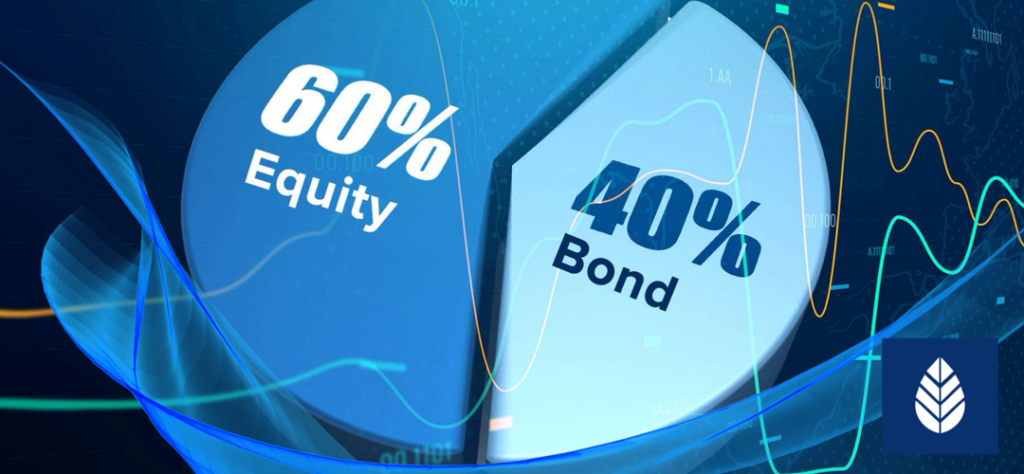
Many client investment portfolios have been built around a traditional buy-and-hold 60 percent stock and 40 percent bond mix. That allocation served as the industry’s comfort zone for decades. However, recent markets exposed its weak spots. In 2022, for example, stocks and bonds fell together, and many “balanced” portfolios felt anything but balanced.
This article examines why that happened, why it can happen again, and how advisors and allocators can improve on the classic 60/40 portfolio allocation.
Why and How the 60/40 Allocation Started
Harry Markowitz, the master of Modern Portfolio Theory, first proposed the idea of a 60/40 portfolio allocation as an ideal in the early 1950s.
Markowitz’s theory was that investors could combine risky assets in a way that delivered the highest expected return for a given level of volatility. Those optimal combinations form the efficient frontier, which has served as the anchor for many allocation decisions for decades.
Over time, the investment management industry converged on a simple rule of thumb. For many moderate-risk investors, a 60 percent equity allocation for long-term growth opportunities and a 40 percent fixed-income allocation to protect against market declines and volatility was perhaps an ideal portfolio allocation.
A 60/40 portfolio allocation became the default for both institutional allocators, RIAs, and advisors. For years, the market environment made the 60/40 mix look like a wise and practical theory. Historical performance reinforced the belief of many that a set allocation could be a complete solution for many investors.
When the Classic Allocation Strategy Failed: 2022
How effective has a 60/40 portfolio performed during market downturns? The 2022 bear market tells the story.
The Federal Reserve raised the federal funds target rate from approximately 0 percent at the beginning of the year to 4.5 percent by year-end. Bond prices fell in response, and many investors sold their equity allocations during the market downturn, or a large portion of them.
The familiar relationship between stocks and bonds shifted, as the correlation increased. The typical 40 percent bond allocation delivered little diversification to the 60 percent stock allocation.
Many advisors have relied on basic 60/40 allocations without thinking about it, often because the strategy had been accepted for decades as a standard.
The big drawdowns of 2022 exposed the limits of a 60/40 allocation. Clients who expected the bond allocation to zig when equities zagged saw both sides of their portfolio decline together.
Both asset classes posted double-digit losses in 2022. The S&P 500® Index declined 18.1 percent during the year, while the Bloomberg U.S. Aggregate Bond® Index fell 13.0 percent. According to Callan in May 2022, “there have been only two calendar years when stocks and bonds were both down, 1931 and 1969.”
The maximum drawdown for the S&P 500 during 2022 was approximately 24.5 percent (from its January peak to October trough); for the Bloomberg U.S. Aggregate Bond Index, it was around 18.0 percent.
Maximum drawdown is the largest peak‑to‑trough decline during the period from January 1 through December 31, 2022.
In dollar terms, the impact of drawdowns becomes stark. A 25 percent drawdown in a few months means that a $1,000,000 portfolio would decrease, at least on paper, to $750,000. To make matters worse, recouping the lost $250,000 would require a 33 percent gain, not 25 percent.
Why Bonds No Longer Offset Equity Risk the Way They Used To
The 2022 experience was not unique in market history. It was simply the first time in a generation that many advisors and clients lived through such a market shift. The root cause lies in correlations.
Correlation describes how two investments move relative to each other over time. A correlation close to one means they tend to move together. A correlation near zero means they move independently. A negative correlation means they tend to move in opposite directions.
Historically, stock and bond correlations have not been stable. From November 2000 through 2020, rolling three-year correlations between stocks and bonds were negative or close to zero. That two-decade stretch created an environment where bonds reliably offset equity volatility. Inflation remained low, as did interest rates.
Stock and Bond Correlation in Key Market Environments Since 2000
According to Morningstar, stock and bond relationships have shifted meaningfully across recent markets, reflecting changes in inflation, interest rates, and growth expectations:
- Correlations between stocks and bonds were positive in 2021 and remained above 0.5 from 2022 through 2024.
- From 2022 to 2024, the correlation was above 0.5; the market featured high inflation and several interest rate hikes.
- For the 12 months ended April 2025, the correlation was approximately 0.3. The market was characterized by an uncertain inflation outlook.
Historical episodes have reinforced this pattern. During the 1970s, another period marked by high inflation, stocks and bonds also moved together more frequently. Over the long term, when inflation uncertainty has dominated the market, both asset classes have tended to decline in tandem.
Uncorrelated Does Not Necessarily Mean Diversified
Many allocators and advisors have responded to the problem of a lack of diversification by searching for uncorrelated returns.
The goal was to find investments that behaved differently from traditional stocks and bonds. That is why many non-core allocation strategies over the past several years have begun to include alternative investments like private equity, private credit, commodities, real assets, or hedge funds.
However, this approach was largely misguided. Investors don’t want uncorrelated returns; they want maximum correlation when the markets are going up, and uncorrelated or inverse correlation when the market is going down. They want strategies that participate when markets move higher, and then behave differently only during the worst periods.
In other words, they seek high correlation in bull markets and low or inverse correlation in bear markets. Diversifiers should help improve client outcomes during major corrections and bear markets without giving up the ability to compound during extended uptrends.
Moreover, “uncorrelated” in many cases does not mean true asset diversification. An allocation that returns ten basis points a month with little connection to equities is technically uncorrelated, yet it may not add meaningful value.
The evidence suggests that a traditional 60/40 portfolio has, in the past, faced challenges that go beyond short-term market conditions. A 60/40 mix may struggle both to grow meaningfully above inflation and to provide adequate downside protection during stress periods.
The 2022 market decline exposed a fundamental flaw. When correlations shifted and both stocks and bonds declined at roughly the same time, the diversification benefit that made a 60/40 allocation attractive disappeared. Advisors and allocators who continue to rely on this allocation risk repeating 2022’s painful results.
A Tactical Approach to Improving on the 60/40 Allocation
What’s an allocator, and an investor, to do? In many cases, the answer is to use a tactical investment strategy. A tactical strategy is an active portfolio approach where managers systematically adjust asset allocations based on market conditions. The goal is to create the opportunity to participate in rising markets and move defensively during down markets.
Instead of holding a static mix like 60/40 at all times, tactical managers may shift between equities, bonds, and defensive assets such as cash, Treasuries, gold, and other assets, to improve risk‑adjusted returns.
Tactical managers aim to participate during equity rallies and then shift to defense only when market conditions deteriorate. This is a differentiated and unconventional approach.
During bear markets, many of these managers may not seek to hold assets through the entire drawdown. They can shift into defensive positions that historically have held up better during sharp equity declines. Some managers may shift from 100 percent equity allocation to zero during market sell-offs.
Many such approaches use systematic, rules-based processes designed to be consistent and repeatable, and rely on large, low-cost ETFs for broad exposure.
According to AQR, a global quantitative investment manager, stocks and bonds have historically helped diversify portfolios when growth news dominates and is a weaker diversifier when inflation dominates.
To that end, in a market with uncertain, elevated inflation, investors may consider reducing their core portfolio and increasing the remaining portion to restore diversification. Instead of the traditional 60/40 allocation, a 50 percent core, 50 percent satellite structure may better address the risk that stocks and bonds move together when inflation pushes correlations higher.
By raising allocations to alternative diversifiers in the satellite sleeve, investors can seek growth and capital preservation that are less tied to the stock–bond market cycle, and more resilient to market volatility and inflation upticks.
How have tactical strategies performed during bear markets?
Unlike static allocations that remain fully invested regardless of market conditions, tactical strategies can shift to defensive positions when equity markets face severe drawdowns.
In periods like the 2022 bear market, the COVID shock, and the fourth quarter of 2018, we believe that tactical flexibility helped reduce downside returns compared with static allocations.
Frequently Asked Questions about 60/40 Portfolios and Tactical Strategies
What role can tactical strategies play inside model portfolios?
Tactical strategies often work best as a dedicated sleeve within a broader model or multi-manager lineup, rather than as a complete replacement for core equity or fixed income.
Allocators can allocate a defined percentage of the portfolio to one or two complementary tactical approaches, then monitor how those sleeves affect overall drawdowns, volatility, and recovery times. The result may be a more resilient overall allocation. Clients still see the equity growth they expect in strong markets. During major corrections, they may also see meaningful portions of the portfolio that behave differently and, in some cases, move higher.
How can advisors communicate the risk of whipsaw trades to clients considering tactical allocations?
Tactical strategies, especially those that rely on trend and technical signals, can experience whipsaw when markets reverse quickly, and signals lag.
A whipsaw is an investment result in which an investment manager sells a security based on a predefined signal, such as a trigger from price trends, moving averages, or volatility measures, only for the market to reverse course. The result is often a portfolio loss or a missed opportunity for gain. These triggers are rules-based conditions that tell a tactical strategy when to shift between risk assets and defensive positions.
Advisors can explain that this is the tradeoff for having a rules-based risk management process. The key is to position whipsaw as an acceptable cost of seeking better protection in major drawdowns, and to show clients evidence that occasional short-term frustration can be offset by improved outcomes over full market cycles.
Are tactical strategies worthwhile in today’s market?
No one knows exactly when the next “2022 moment” will arrive, yet it is reasonable to expect another period when stocks and bonds struggle together. Allocators and advisors who prepare portfolios now, while conditions feel calmer, put their clients in a stronger position when that happens.
Interest rates are higher than they were a few years ago and will move over time. Global risks and macro uncertainty remain ever-present. Changes in inflation, policy, and market structure can shift correlations again.
In Summary: Why a Classic 60/40 Portfolio Allocation May No Longer Protect Clients in Downturns
The 60/40 portfolio allocation theory historically worked well in an environment of falling interest rates and benign inflation. That has ended, at least for now. Moving forward, advisors may need portfolios designed for the realities of higher correlations, inflation uncertainty, and more frequent periods when traditional diversification fails.
By adding diversifiers and tactical strategies around a core portfolio, it is possible to build portfolios that seek high participation in rising markets and better protection in severe declines.
For firms and investors that want to explore what this could look like in their portfolios, now may be an opportune time to reassess the role of 60/40. Find out how you can get started.
About McElhenny Sheffield
McElhenny Sheffield believes that avoiding material losses is the foundation of successful long-term investing. Risk management and capital preservation are the firm’s top priorities.
The firm is committed to protecting investors’ financial futures through a proven rules-based, momentum and trend-following tactical ETF strategy, and positioned as a tactical allocation for advisors who need to protect their clients’ core portfolio while still seeking growth.
Clients include independent-thinking investment advisors across the U.S., large investment allocators, and high-net-worth individuals and families looking for a second opinion. McElhenny Sheffield also provides sub-advisory services for RIAs and financial advisors. The firm was founded in Dallas, TX, in 2000, and as of March 31, 2026 manages more than $760 million in assets under management.
Past performance is not necessarily indicative of future results. Investing involves risk. Principal loss is possible. The Standard & Poor’s 500 Index is an unmanaged barometer of 500 leading publicly traded, large‑capitalization U.S. companies. The Bloomberg U.S. Aggregate Bond Index is an unmanaged, broad‑based benchmark that measures the investment‑grade, U.S. dollar‑denominated, fixed‑rate taxable bond market. It is not possible to invest directly in an index, and performance does not reflect the deduction of fees, expenses, or taxes. There can be no assurance that tactical strategies will be implemented as designed, or profitable, or that clients will not lose money. The tactical strategies use a variety of market indicators and stop levels that seek to identify upward or downward trends in the U.S. equity markets. If an indicator or stop level fails to detect significant downturns in the market, the strategy will continue to be exposed to underlying positions that could lose value during such downward periods. Similarly, if the indicators fail to timely identify a reversal of a downward trending market, the strategies will continue to be exposed to defensive Exchange Traded Funds (ETFs) at a time when there is significant appreciation in the equity markets. Either scenario could result in the strategies underperforming other strategies that do not employ these strategies. There can be no guarantee the tactical strategies will correctly or timely identify the industries, sectors, or asset classes that will outperform during a given quarter or that the strategies will correctly or timely identify market trends. The tactical strategies invest in other investment companies and ETFs which result in higher and duplicative expenses. Investing in ETFs are subject to risks that the market price of the shares will trade at a discount to its net asset value (NAV), an active secondary trading market will not develop or be maintained, or trading will be halted by the exchange in which they trade. The information contained in this article has been obtained from sources believed to be reliable; however, its accuracy, completeness, and timeliness cannot be guaranteed. Any opinions or estimates reflect the author’s judgment as of the date of publication and are subject to change without notice. This material is provided for informational purposes only and should not be construed as legal, tax, or investment advice. Investors should consult their tax advisor or legal counsel for advice and information concerning their particular situation.